01 · The Data Gap3 min read
I went looking for sustainable products and found a data problem
How a 2024 search for trustworthy eco-friendly products became two years of learning about EPDs, LCA, carbon data and the concept built around the gap.
Carbon-aware product management · A field journal
These are my notes on how carbon thinking gets built into products: the data behind a footprint, the standards that shape it, the cost of AI, and the concepts I build to learn. Written by Writam Bugga, a product manager in Seattle.
A missing product label
Certifications and supplier data
EPDs and life cycle assessment
Scope 1, 2 and 3 accounting
ESG reports and compliance
1.5°C targets
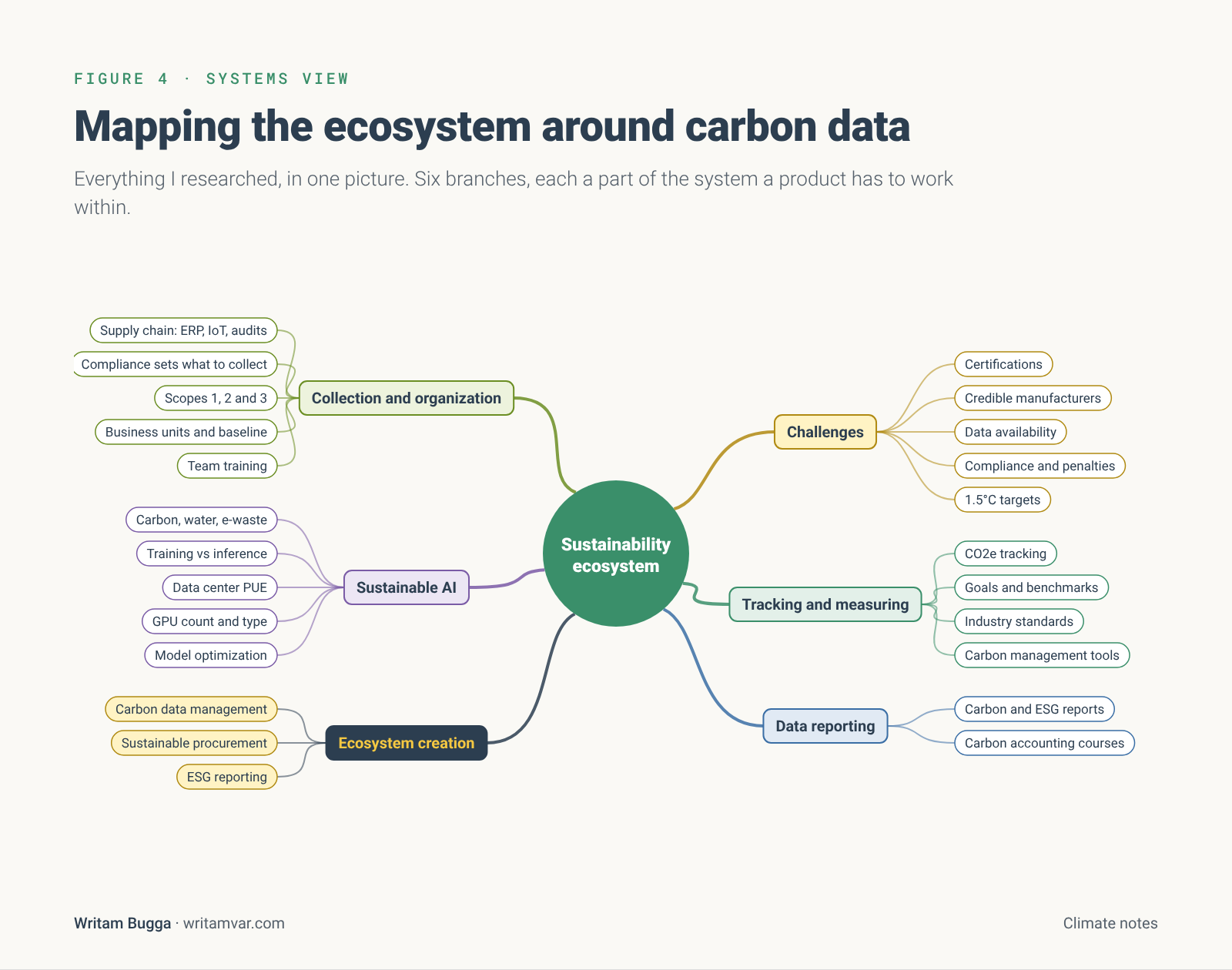
Drawn from the map I made while learning. Each theme has its own notes, sources and common questions.
Why product carbon data is missing, and who pays for it.
Theme 02Collect, organize, train, track, and the standards behind each step.
Theme 03Software carbon intensity, PUE, training vs inference, the agent iceberg.
Theme 04Carbon as a product metric, LCA for PMs, daily habits.
Theme 05Things built to learn: concepts, prototypes and side projects.
How a 2024 search for trustworthy eco-friendly products became two years of learning about EPDs, LCA, carbon data and the concept built around the gap.
A market reading of digital EPD infrastructure: why moving declarations from PDFs to structured data matters, and where product opportunities sit.
A working playbook for building carbon thinking into everyday product management: daily habits, the first month, and growing into climate leadership.
Most carbon tools are built for enterprises, but small and medium businesses carry much of the supply chain. Why that gap matters, and what tools could do.
A field guide to measuring and reducing the footprint of software, websites and AI: open standards, calculators, data sources and where each fits.
For climate tech teams
I have done early-stage product work three times across different sectors, and I build and run my own experiments end to end. The core of any work I would do: the organization and sector, LCA data sources, reporting and compliance, multi-sector reach, personas and segmentation, and AI and data governance.